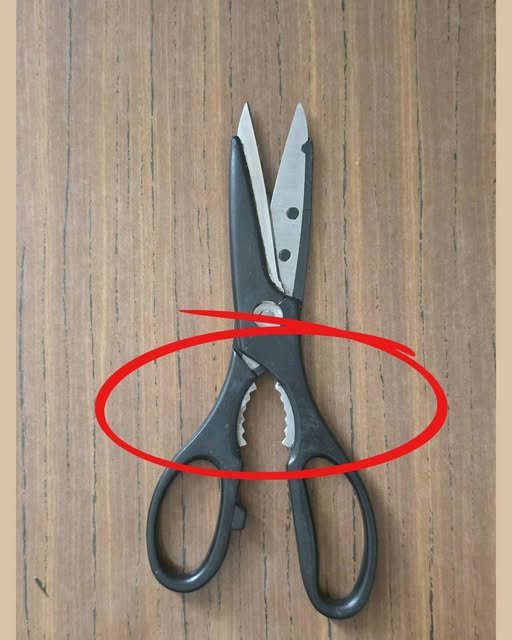
You’re not alone—those little metal teeth have drawn blood and caused confusion in kitchens everywhere. They’re not a design flaw or a manufacturing error. They have a very specific job.
They’re a bottle opener and a jar lid loosener.
More precisely, that notched, serrated section between the handles, right at the hinge where the blades meet, is a multi-purpose gripping tool. Here’s how it works:
The Two Functions
1. Bottle Opener
The curved, hook-like section of the notch grips the underside of a metal bottle cap. You position the cap in the notch, squeeze the scissors handles together slightly so the notch clamps the cap’s edge, and lever upward. It functions the same way a waiter’s corkscrew bottle opener does.
2. Jar Lid Gripper / Twist-Off Cap Opener
The serrated “teeth” are designed to bite into the ridged edge of a stubborn jar lid, soda bottle cap, or twist-off beer cap. You open the scissors wide, clamp the notch around the lid so the teeth dig into the ridges, and use the scissor handles as a long lever to twist the lid open. The length of the scissor handles gives you far more torque than your bare hand.
Why It’s So Frustrating (and Dangerous)
The design is fundamentally annoying because the teeth are positioned precisely where your index finger and thumb naturally slide when you’re cutting with any force. When you bear down on the scissors, the handles flex slightly, and your hand can slip forward into that serrated notch.
Until you retrain your grip, try this:
-
Choke up consciously. Grip the handles farther back, away from the hinge. This feels less precise at first but keeps your fingers clear of the teeth.
-
Wrap the area. A few tight passes of electrical tape or a small piece of self-adhesive silicone tape wrapped around just the metal teeth (not the hinge itself) will blunt the bite without affecting the function. It won’t look pretty, but your fingers will thank you.
-
Identify the culprit. If these are multi-purpose kitchen shears that pull apart into two pieces for cleaning, the bottle opener is usually on the blade-side half. Knowing this, you can be extra vigilant when separating and reassembling them—that’s when most people get caught.
A Quick Note on the Design
This feature is most common on Asian-style kitchen shears and heavy-duty poultry shears, less so on classic European sewing scissors. If yours come apart at the hinge for cleaning, the teeth also serve as a wren-like grip for dismantling chicken joints or cracking small bones, but the primary intended use printed on most packaging is indeed the bottle and jar opener.
You’re not careless. They’re just placed in exactly the wrong spot for how human hands apply pressure.