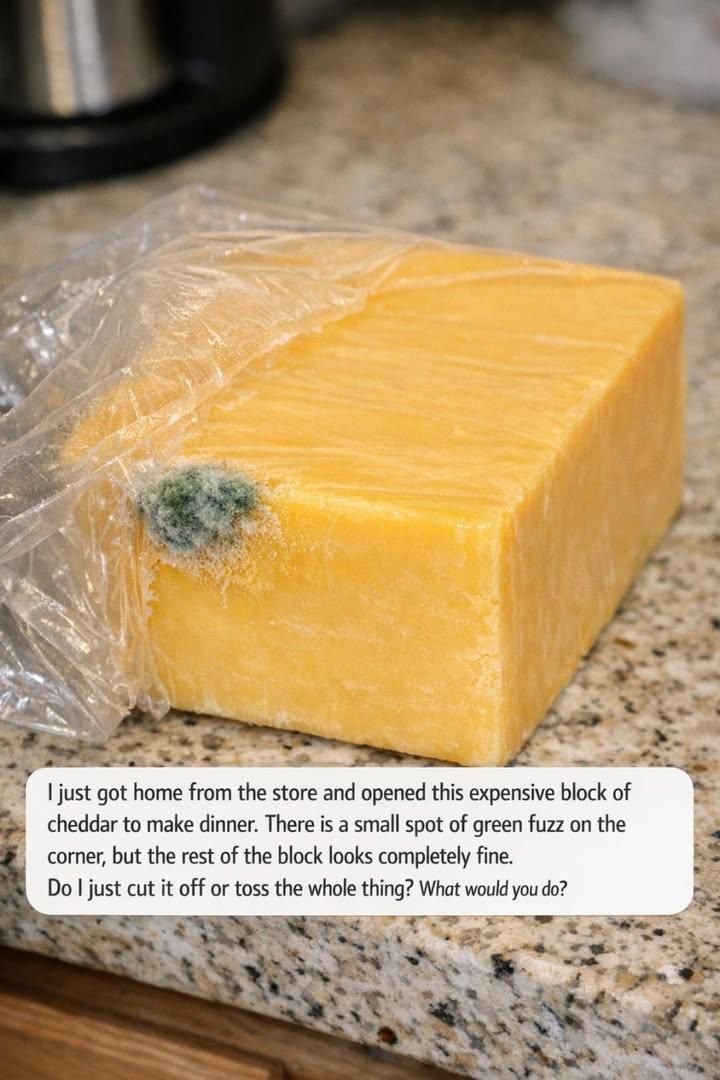
That’s a great question, and the answer is different for hard cheeses like cheddar than it is for soft cheeses. Since you’re dealing with an expensive cheddar, you’ll be happy to know that you do not need to throw the whole thing away.
Here is the rule of thumb: For hard and semi-hard cheeses (cheddar, Parmesan, Swiss, Gouda), mold generally cannot penetrate deeply into the dense structure of the cheese.
✅ Do This: Cut It Off
You can safely salvage the rest of the block by cutting away the affected area. However, there is a specific technique to ensure safety:
-
Cut generously: Cut at least 1 inch (2.5 cm) around and below the spot of green fuzz. Do not just scrape it off or cut a thin sliver.
-
Keep the knife clean: Make sure your knife does not touch the moldy spot as you cut, or wash it thoroughly between cuts to avoid cross-contaminating the clean part.
-
Recover carefully: After removing the contaminated section, re-wrap the remaining cheese in fresh wrap or parchment paper.
🔬 Why this is safe
Cheddar is dense and has low moisture. The fuzzy mold you see on the surface is the “flower” of the fungus. While the invisible roots (mycelium) do grow a bit into the cheese, they have a very hard time traveling far through a hard, dry block. Cutting off a full inch ensures you have removed all of those microscopic roots.
⚠️ When to throw the whole thing away (Red Flags)
You should discard the entire block immediately if you see any of the following:
-
Black, red, or orange mold (not just green or white). These colors can indicate more dangerous or toxin-producing molds.
-
A slimy or mushy texture around the mold spot.
-
An ammonia-like or bitter, unpleasant smell coming from the cheese.
-
The cheese is pre-shredded or sliced. Mold on shredded or sliced cheese is a total loss, as the increased surface area allows contamination to spread too easily.
🧀 A note on the “green” mold
The common green mold on cheddar is usually Penicillium (a relative of the good mold in blue cheese). While it’s not dangerous in small amounts for healthy people, it can taste bitter or musty, and people with mold allergies or compromised immune systems should be extra cautious.
The bottom line: For your block of expensive cheddar, cut off a 1-inch margin around the green fuzz, and enjoy the rest.