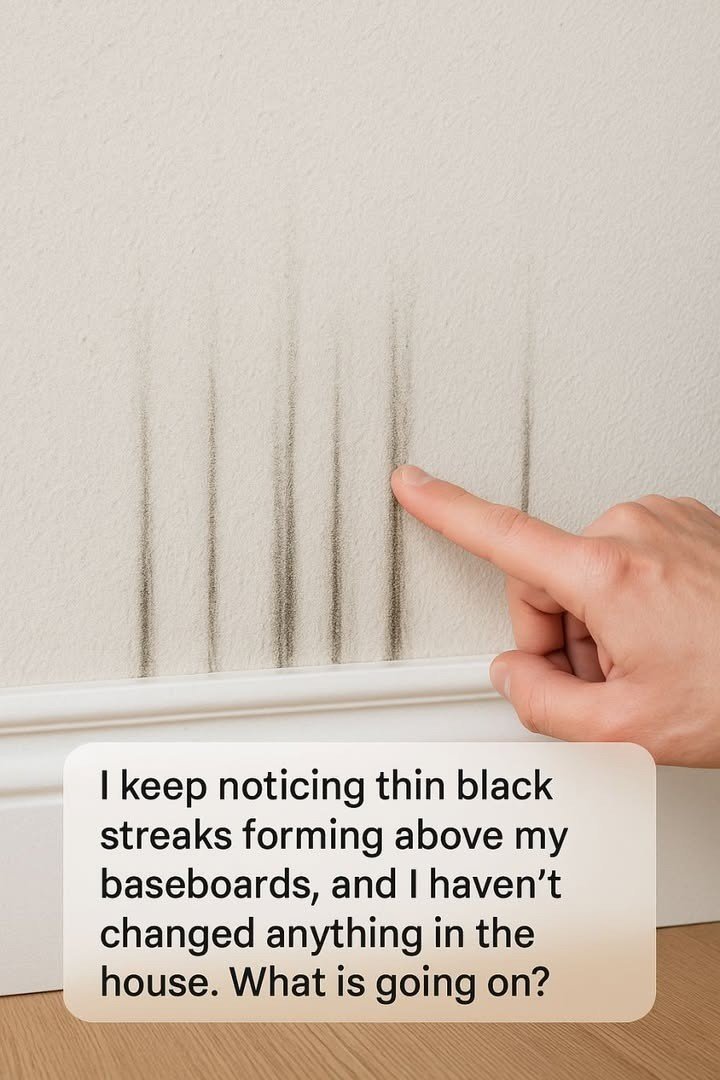
The thin black streaks you are noticing are most likely a common phenomenon known as ghosting or thermal tracking. This is not a sign of mold or a major house defect, but rather a physical process where soot and dust particles in the air cling to specific spots on your walls.
Think of it as your home’s air currents leaving behind a “fingerprint” of the particles they carry.
🔍 Why This Happens Above Your Baseboards
The appearance of these streaks comes down to a combination of three things: temperature, air movement, and particles.
-
Temperature (The “Cold” Factor): The areas above baseboards, especially on exterior walls, are often cooler than the rest of the room. This can be due to the framing of the house (studs conduct cold more than insulation does) or tiny gaps where air leaks in. This cool surface causes a microscopic layer of moisture to form, making it sticky.
-
Air Movement (The “Draft” Factor): Your heating system creates convection currents. Warm air rises from the baseboards, circulates around the room, and then cools and descends along the exterior walls. As this air travels, it carries microscopic particles with it.
-
Particles (The “Source” Factor): The air in every home contains invisible particles. Common sources that make ghosting worse include:
-
Burning candles, especially scented ones.
-
Smoking indoors.
-
Fireplaces and wood stoves.
-
Cooking, particularly frying without using an exhaust fan.
-
Dust, dead skin cells, and textile fibers.
-
When the warm, particle-filled air hits the cooler wall surface above your baseboard, the particles are deposited there, slowly building up into the dark streaks you see.
🆚 Ghosting vs. Mold: How to Tell the Difference
It is very common to confuse these stains with mold, but you can usually tell them apart with a quick visual check.
| Feature | Ghosting / Thermal Tracking (Likely Your Issue) | Mold |
|---|---|---|
| Pattern | Straight lines, streaks, or geometric patterns that follow wall studs or the edges of the floor. | Irregular, spreading spots or blotches. |
| Texture | Flat, dusty, or smudgy. It may wipe away with a damp cloth. | Fuzzy, slimy, or velvety texture. |
| Smell | Usually no smell, or perhaps a faint smoky or dusty odor. | A distinct musty or earthy smell. |
| Wipe Test | Often wipes off easily as a gray or black smudge. | Does not wipe off cleanly and may smear or damage the paint. |
🛠️ How to Fix and Prevent It From Coming Back
Since the root cause is a combination of particles and cool surfaces, the solution involves reducing both. Simply painting over the marks will only hide them temporarily, as they will bleed through again unless you address the underlying issue.
Here is a step-by-step plan to fix the problem for good:
-
Clean Thoroughly: Before you do anything else, thoroughly clean the affected walls. A mild detergent solution or a specialized wall cleaner (like TSP, trisodium phosphate) can remove the soot. Make sure to let the walls dry completely.
-
Seal and Paint: After cleaning, apply a high-quality stain-blocking primer (like shellac or oil-based primer) to the affected areas. This will seal the remaining stain so it cannot bleed through. Then, repaint with your desired topcoat.
-
Reduce Airborne Particles: This is the most important step for long-term prevention.
-
Stop burning candles, or switch to unscented beeswax or soy candles with trimmed wicks.
-
Always use the exhaust fan over your stove when cooking.
-
If you have a fireplace, ensure it is drafting correctly and is serviced regularly.
-
Vacuum carpets and upholstery frequently using a vacuum with a HEPA filter.
-
-
Upgrade Your HVAC System: Your heating and cooling system plays a major role.
-
Change your furnace filter regularly (every 60-90 days) and upgrade to a higher-quality filter with a MERV rating of 11-13 if your system allows.
-
Consider sealing the gap between your baseboard and the floor with a small bead of clear caulk. This prevents dirty air from being pulled up from the subfloor or basement by air pressure imbalances.
-
-
Improve Insulation (Long-term Fix): For a more permanent structural solution, improving the insulation in your exterior walls can help keep the wall surface warmer, reducing the “cold spots” that attract particles.
In short, the black streaks are soot and dust, not mold. You can fix them with thorough cleaning and stain-blocking primer, but to keep them away for good, focus on reducing indoor air pollution from candles and cooking, and be diligent about changing your HVAC filter.
I hope this helps you solve the mystery!