1. The Inescapable “Invisible Woman” Fear
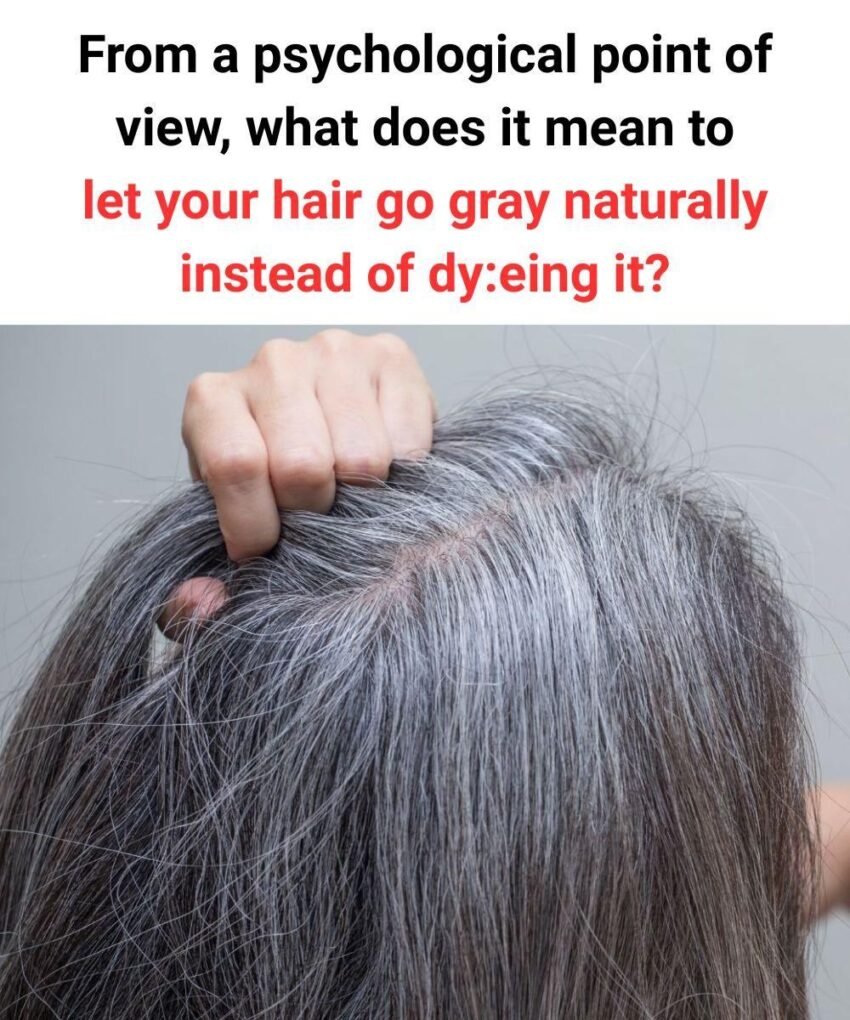
For women, visible aging has long been punished with a specific kind of irrelevance. Gray hair is the most immediate, undeniable sign that you are no longer 35.
-
The discomfort is projection: People aren’t uncomfortable with your hair; they’re uncomfortable with what it reminds them of—aging, mortality, and the loss of conventional female value. Telling a woman she “looks old” with gray hair is often a way of policing her right to be seen, to be sexual, to take up space.
-
The double standard is brutal: A man with gray is a “silver fox”—distinguished, experienced, desirable. A woman with gray is quickly judged as having “let herself go.” This gap reveals that the discomfort isn’t about aesthetics, it’s about control.
2. The Disruption of the “Natural Order”
Gray hair in men signals a linear career and rising status. Gray hair in women signals a departure from fertility, which patriarchal structures have historically framed as a woman’s primary source of power.
-
When a woman proudly wears her gray, especially styled sharply, she’s refusing to apologize for aging. This challenges the entire multi-billion-dollar anti-aging industry, which depends on women feeling their natural state is a problem to be fixed. That industry’s marketing has trained us for generations to see gray as a “fault” so the solution can be sold.
3. The Texture and the “Unruliness” Metaphor
Gray hair isn’t just a loss of pigment; its texture often becomes coarser, wirier, and more independent.
-
Symbolic defiance: This physical change can be read as the hair—and by extension, the woman—becoming “unruly” and harder to control. This mirrors a real psychological shift: many post-menopausal women report feeling a newfound confidence, a loss of the need to please. The discomfort is a reaction to a woman becoming more herself and less what society expects.
4. Professional Punishment
In many workplaces, the pressure to dye remains intense, couched in merciless code words.
-
“She looks tired” almost never means sleep deprivation. It’s the coded weapon against gray roots, less-bright eyes, and softer jawlines.
-
“She’s not a good culture fit” can hide ageism. A woman with all-gray hair is undeniably older in a startup or creative industry that ties “culture” to youth and overnight energy.
-
The “keep up” trap: A woman who dyes her hair is maintaining a standard; a woman who doesn’t is seen as lacking “executive polish.” This forces an unfair choice: spend time and money on a perpetual chemical disguise, or risk being passed over.
5. It Forces Others to Confront Their Own Choices
The discomfort is often a deeply personal mirror. When a woman in a friend group or family stops dyeing, she inadvertently becomes a walking question for everyone else.
-
She makes other people ask themselves: Am I still dyeing for joy, or out of fear? Is my youth-worship keeping me from something more genuine? That cognitive dissonance is uncomfortable. It’s far easier to label her choice as “drab” than to examine your own.
6. The Loss of a Safety Signal
For decades, the bottle of hair dye was a signal that said, “I’m still in the game. I still care. I still color within the lines.” Going gray removes that signal. It leaves an ambiguity that can unsettle people. They’re not sure how to categorize you, and they’re afraid you’ve given up—when in reality, you’ve often just given up a time-consuming, expensive chore.
The Cultural Shift: Why It’s Happening Anyway
The discomfort goes both ways, and it’s being faced down by a powerful counter-movement.
-
The pandemic pivot: Lockdown forced millions of women to see their natural growth for the first time in decades, and many realized they loved the freedom and the shimmer.
-
Rebranding through language: It’s no longer “going gray”—it’s a “silver transition,” a “silver pixie,” a “champagne platinum.” This reclamation steals back power from the “old” label.
-
Visibility and rebellion: Celebrities like Andie MacDowell, Tracee Ellis Ross, and Meryl Streep have made silver hair a high-fashion, deliberate choice, not a surrender.
-
Aging out of caring: The most potent reason is that after 50, many women simply lose the desire to perform aesthetic compliance for others. The authentic self finally feels bold enough to live on the outside. The discomfort of someone else is a small price for that liberation.
Your earlier questions debunked health scares. This one touches on something equally true: Sometimes, making people uncomfortable is a sign that you’re doing something right for yourself. Gray hair isn’t a problem to solve; it’s often the prize for surviving long enough to earn it.